Redstone Signal & Timing Calculator
Java EditionThree redstone questions in one place: how far a signal goes and where repeaters are needed, how long a chain of repeaters, comparators, torches and observers takes, and what a comparator reads from a chest, hopper or furnace.
What do you want to work out?
Redstone line
From the first dust next to the source to the target
Lever, button, torch, redstone block: 15
Result
Dust strength from the source
- #115
- #214
- #313
- #412
- #511
- #610
- #79
- #88
- #97
- #106
- #115
- #124
- #133
- #142
- #151
- #160
How to use the Redstone Signal & Timing Calculator
5 steps · 19 s · no sound
How it works
A power source gives the dust next to it a signal strength of 15, and every further block of dust loses 1. After 15 dust the signal is gone, so the 16th block of a long line must be a repeater, which outputs a fresh 15. That's one repeater per 16 blocks.
Delays are counted in redstone ticks: 2 game ticks, or 0.1 seconds at the normal 20 ticks per second. A repeater waits 1–4 redstone ticks (right-click to change), a comparator, a redstone torch and an observer 1 each, and dust carries a signal instantly.
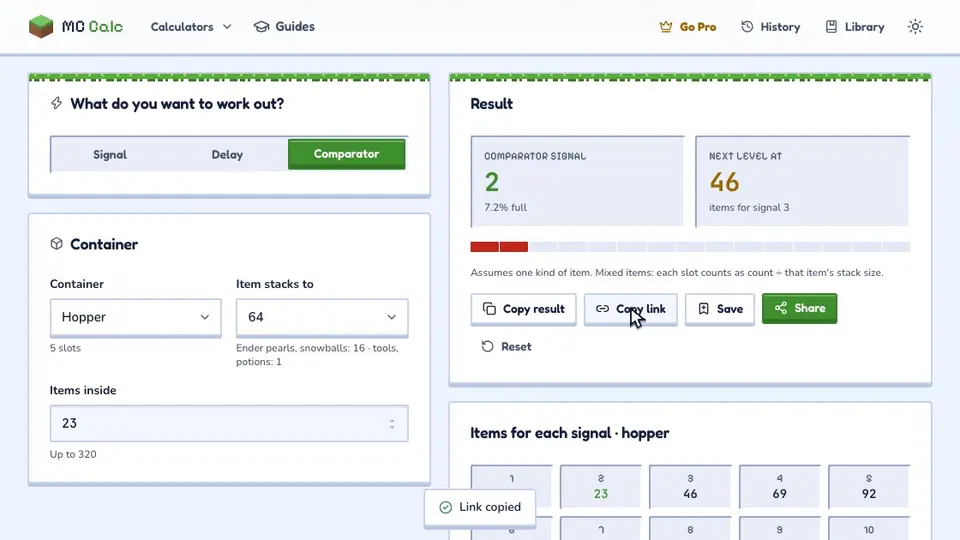
A comparator behind a container measures how full it is. Each slot counts as its item count divided by that item's stack size, the total is divided by the number of slots, and the signal is that fraction × 14, rounded down, plus 1 — but only if anything is inside. That's why 23 items in a hopper give 2 (the trigger in the classic item sorter) and a single sword gives 3.
Mechanics are Java Edition. Bedrock has the same signal strengths, repeater delays and comparator formula for these containers, but its redstone has different update order and a few component timings differ, so very tight Bedrock timings should be tested in game.
Formulas
- Dust
- strength = 15 − (blocks from the source − 1) · one repeater per 16 blocks
- Delay
- seconds = redstone ticks × 2 ÷ 20 · repeater 1–4 rt, comparator/torch/observer 1 rt
- Comparator
- signal = ⌊Σ(count ÷ stack size) ÷ slots × 14⌋ + 1 (0 if empty)
- Items for signal n
- ⌈slots × stack size × (n − 1) ÷ 14⌉ (n ≥ 2)
FAQ
How far does a redstone signal travel?
15 blocks of dust from a full-strength source. Put a repeater on the 16th block to boost it back to 15, then another every 16 blocks after that.
How many items for a comparator signal of 2 from a hopper?
23 stackable items. That's why item sorters put 18 of the sorted item in the first slot and one blocker item in each of the other four (22 in total): the 23rd item tips it to signal 2.
How long is a repeater delay in seconds?
A repeater on its first setting waits 1 redstone tick (0.1 s); on its last, 4 redstone ticks (0.4 s). Ten repeaters at maximum delay add 4 seconds.
How many items fill a chest to signal 15?
A completely full chest: 27 stacks, 1,728 items of something that stacks to 64. Signal 14 needs 1,605 items.
Guides
Redstone signal strength and timing: dust, repeaters, ticks and delays
How far a redstone signal travels, where repeaters go, how redstone ticks convert to seconds, and how to build a delay of any length. Guide · 5 min readComparators and containers: how many items for each signal strength
The comparator fill-level formula, item counts for every signal strength in chests, hoppers and droppers, and why sorters use 18 items plus 4 blockers. Guide · 5 min read
Related calculators
Tick ↔ Real-Time Converter
Convert game ticks, redstone ticks, seconds and in-game days, including at custom tick rates, and read any tick count as a time of day.TechnicalStorage & Hopper Calculator
Convert items to stacks, chests, double chests and shulker boxes, and see how long hoppers take to move them.Farms & ResourcesFarm Rate Calculator
Items per hour for iron farms and crop farms — wheat, carrots, potatoes, melons, pumpkins, sugar cane and cactus.Farms & Resources