Crop Growth Time Calculator
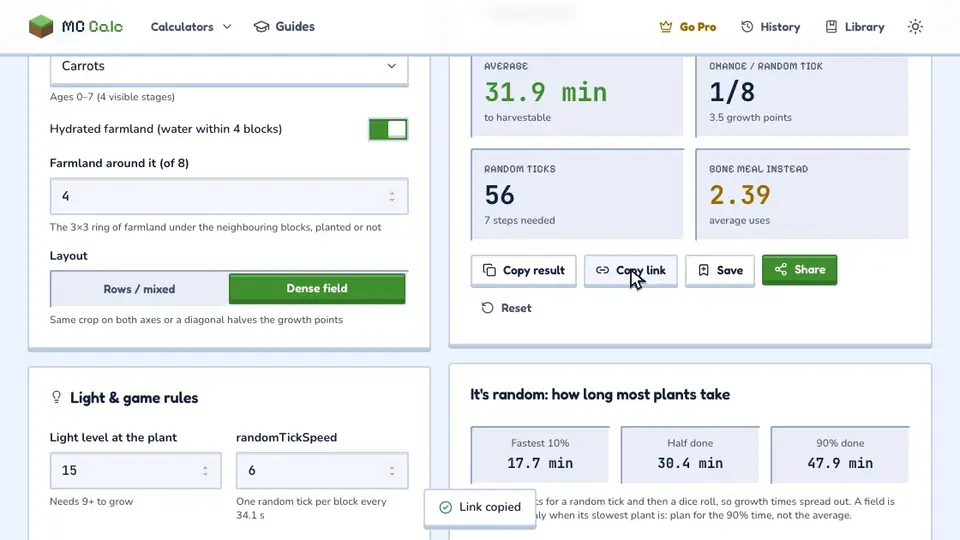
Java EditionSet the crop, the farmland around it, the light and the random tick speed. See the chance per random tick, the average time to harvest, how long it takes for most plants (10%, 50%, 90%) and how much bone meal you'd need instead.
Crop
Ages 0–7
The 3×3 ring of farmland under the neighbouring blocks, planted or not
Same crop on both axes or a diagonal halves the growth points
Light & game rules
Needs 9+ to grow
One random tick per block every 68.3 s
Growth time
It's random: how long most plants take
- Fastest 10%
- 13.3 min
- Half done
- 22.8 min
- 90% done
- 35.9 min
Each step waits for a random tick and then a dice roll, so growth times spread out. A field is fully grown only when its slowest plant is: plan for the 90% time, not the average.
How to use the Crop Growth Time Calculator
5 steps · 22 s · no sound
How it works
Plants grow only when they receive a random tick. With the default randomTickSpeed of 3, a given block is picked about once every 68 seconds — but that is an average, so two identical plants can finish minutes apart. The calculator shows the expected time plus the times by which 10%, 50% and 90% of plants are done.
Wheat, carrots, potatoes, beetroots and melon/pumpkin stems use growth points from the farmland: 3 for the hydrated farmland they sit on (1 if dry), plus a quarter of that for every farmland block in the 3×3 around it. The chance to grow one stage on a random tick is 1 ÷ (⌊25 ÷ points⌋ + 1): 1 in 3 at best. If the same crop surrounds the plant on both axes or on a diagonal, the points are halved and the chance falls to 1 in 6.
These crops also need a light level of 9 or more at the plant (sunlight or torches). Beetroots ignore one random tick in three but have only 3 stages. Stems need 7 stages, then try to place a fruit on a random side, so free spots matter. Sweet berries and cocoa grow with a flat 1-in-5 chance, nether wart 1 in 10, and sugar cane and cactus add a block every 16 random ticks.
Bone meal skips the wait: wheat, carrots, potatoes and stems jump 2–5 stages per use, beetroots have a 75% chance of one stage, berries and cocoa one stage. Nether wart, sugar cane and cactus can't be bone-mealed in Java. Bedrock Edition uses a different random tick system, so its times differ; these numbers are Java Edition.
Formulas
- Random tick interval
- game ticks = 4096 ÷ randomTickSpeed (≈ 68.3 s at 3)
- Growth points
- f = 1 + below (hydrated 3, dry 1) + ¼ × each of the 8 neighbouring farmland · ÷ 2 in a dense same-crop field
- Chance per random tick
- p = 1 ÷ (⌊25 ÷ f⌋ + 1) · beetroots × ⅔ · berries, cocoa 1/5 · nether wart 1/10
- Expected time
- stages ÷ p × 4096 ÷ randomTickSpeed ÷ 20 seconds
FAQ
How long does wheat take to grow in Minecraft?
On hydrated farmland in rows, with light level 9+, about 24 minutes on average (21 random ticks). About 1 plant in 10 is done within 13 minutes and 1 in 10 takes longer than 36, because growth is random. In a dense field of only wheat it doubles to about 48 minutes.
Does hydrated farmland make crops grow faster?
Yes, a lot. A crop on hydrated farmland surrounded by hydrated farmland has a 1-in-3 chance per random tick; on dry farmland it's 1 in 7, so dry crops take more than twice as long.
Do crops grow at night?
Only if the light level at the crop is still 9 or more, for example from torches or glowstone. Under the night sky alone they stop growing, and in light level 7 or lower they can't even be planted.
How much bone meal to fully grow wheat?
2.39 on average: each use adds 2–5 stages at random and wheat needs 7. Beetroots need 4 on average because each use only has a 75% chance of adding one stage.
Guides
Related calculators
Farm Rate Calculator
Items per hour for iron farms and crop farms — wheat, carrots, potatoes, melons, pumpkins, sugar cane and cactus.Farms & ResourcesTick ↔ Real-Time Converter
Convert game ticks, redstone ticks, seconds and in-game days, including at custom tick rates, and read any tick count as a time of day.TechnicalStorage & Hopper Calculator
Convert items to stacks, chests, double chests and shulker boxes, and see how long hoppers take to move them.Farms & ResourcesVillager Trading Price Calculator
The real price of a villager trade after curing, Hero of the Village, reputation and demand — and the emeralds for a whole batch of trades.Farms & Resources